English
 español
 العربية

Driven by "dual-carbon" goals, energy consumption among buildings has become the key module of energy saving and low carbon emission for all societies. No matter if it is for residential buildings, apartments, shopping malls, hotels, office buildings, or other commercial buildings, they will consume much electricity or fuel for space heating, cooling, and domestic hot water. Instead, air-source heat pumps and ground-source heat pumps are becoming the major solutions for energy saving for residential and commercial buildings. Many people are curious: by what means do the heat pumps achieve massive energy savings?
Traditional electric heating and gas boilers have an energy conversion ratio of no more than 100%, which consumes energy to produce heat. While the heat pumps operate on a different mythology: they consume less electricity as the motivation to abstract low-grade thermal energy from sources like air, soil, or groundwater and transfer it to the building for heating. They reverse this process in winter, cooling in the building and moving heat from indoors to outdoors.
We normally measure the efficiency of heat pumps by COP value (Coefficient of Performance).
COP = Heat Output ÷ Electricity Input.
Electric heating: COP≈1, meaning consuming 1 kW of electricity equals 1 unit of heat at most.
High-quality heat pumps: their COP value could reach 3 - 5, meaning consuming 1 kW of electricity could equal 3 - 5 units of heat. In other words, under the same capacity of heating demand, a heat pump only consumes 1/3 and even less electricity compared with electric heating. That's the fundamental source of energy efficiency for heat pumps.
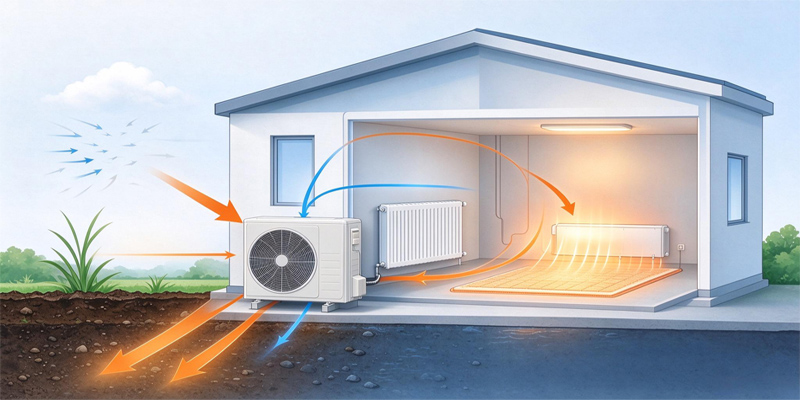
Residential scenarios usually use "tri-generation," providing space heating, central air conditioner cooling, and domestic water heating.
Multi-purpose for year-round operation: One heat pump system simultaneously suffices for heating, cooling, and year-round domestic water heating without the additional purchase of boilers, air conditioners, and water heaters. This reduces the overall energy consumption.
Suitable for low-temperature radiat systems: Utilized with ground heating, the supplied water temperature is around 40℃ only. Compared with high-temperature radiator heating, this makes the heat loss much lower, providing comfort and reducing energy consumption at the same time.
Smart inverter adjustment: Inverter heat pumps could automatically adjust the power output according to room temperature, and frequent start-ups will not happen under low-load operation, avoiding additional electricity consumption during frequent start-ups.
Actual practices: In newly built houses, self-built rural homes, high-rise residential retrofits, and other projects, the annual energy consumption for space heating and domestic hot water will decrease 40% - 60% after the replacement of wall-hung boilers.
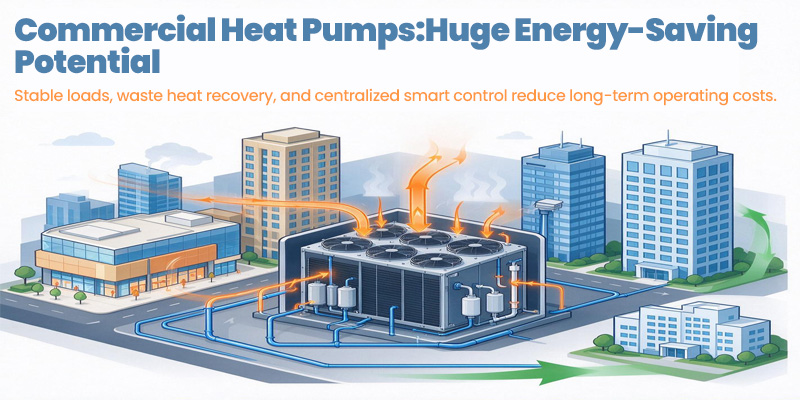
Commercial buildings such as shopping malls, hotels, office buildings, hospitals, and industry zones are major markets for heat pumps, featuring large areas, 24-hour hot water demand, and stable annual cooling and heating loads.
Stable loads and efficiency: Commercial buildings operate with stable cooling/heating loads and higher comprehensive energy efficiency, where the heat pump units could obtain high-efficiency working conditions with a long period, while the household appliances operate with frequent fluctuating loads.
Heat recovery and further energy saving: Commercial heat pumps can produce hot water by using the waste heat recovered from the machine and the exhaust air. Their energy-saving stands out in scenarios such as hotels and apartments where hot water is in large demand.
Suitable for central heating supply on a large scale: Several heat pump units can be combined in parallel, providing centralized cooling/heating for the buildings. Integrated with BMS (Building Management System), the heat pump units could adjust the operation dynamically according to the crowds and the temperature in various areas, aiming to avoid energy waste in the building.
Lower operation cost: It's a long-term cost of commercial building energy consumption. Though the initial investment is high for heat pumps, they could pay back in 3-7 years by saving costs for electricity and fuel.
It's not to reach the ideal energy-saving level once the installation is finished, while actual performance may depends on the following:
Insulation performance of buildings: Weak insulation on walls. Doors and windows will hasten the loss of coolness and heat, increase the load of the system, and reduce the energy-saving performance. It's better to improve the insulation conditions for the old buildings and maximize the benefits from the heat pumps.
Model selections: Incorrect calculation of cooling/heating loads and too-small or too-large machine size will all reduce the working efficiency. Precise load calculation is needed for commercial projects.
Installation and piping design: Pipe insulation, piping design, and ventilation conditions will directly influence the heat-exchanging efficiency. Irrational installation will deeply reduce the COP value.
Maintenance: Clean the heat exchanger and filter regularly; this could avoid scale and blockage, ensuring stable heat exchange and keeping high efficiency with long periods.
No matter if it's a residential house, a hotel, an office building, or another commercial place, heat pumps have their core advantage by consuming less electricity to complete cooling and heating supply with the help of free low-grade thermal energy from nature and reduce the energy consumption of buildings fundamentally. In a short time, it needs systematical investment, but it reduces emission of carbon, featuring economic benefits and eco-friendliness in the long run. With the development of heat pump technology and the continuous political support, the heat pumps will be widely popularized between newly built constructions and the renovation of the old ones.


حقوق النشر
@ 2026 قوانغتشو SOUXIN الأجهزة المحدودة جميع الحقوق محفوظة
.
 الشبكة المدعومة
خريطة الموقع / المدونة / Xml / سياسة الخصوصية

Hi! Click one of our members below to chat on